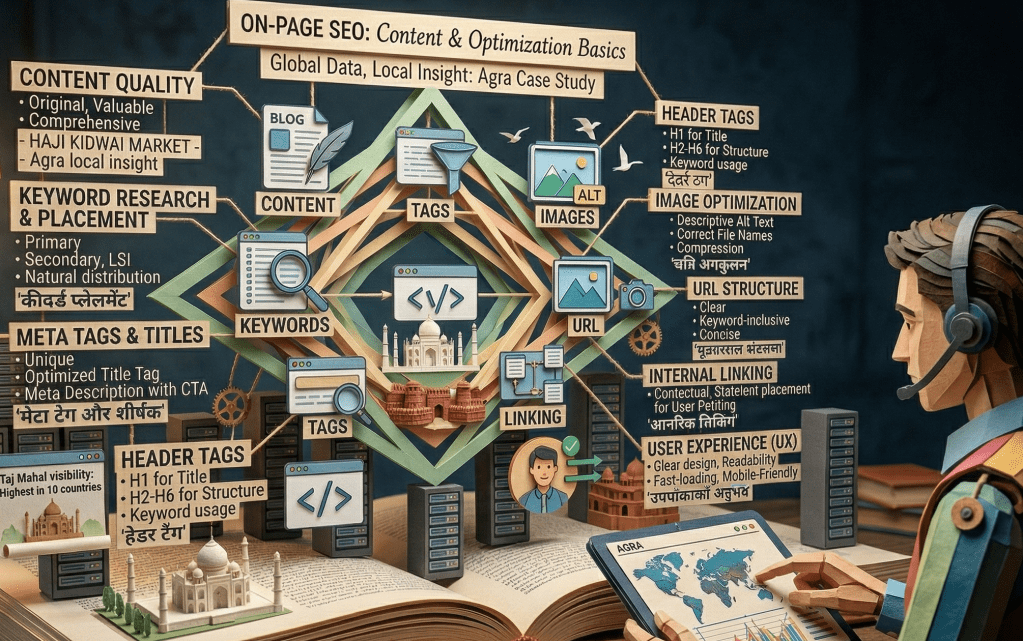
On-Page SEO is No Longer Optimisation—It’s Interpretation
There was a time when ranking content meant placing keywords strategically. Then came search intent.
Now, in 2026, we’ve entered a completely different phase:
Google doesn’t just rank your page. It decides whether your content is worthy of being used in AI-generated answers.
This is the biggest shift.
Search is no longer just a list of links. It’s:
- AI summaries
- Contextual answers
- Personalized results
- Zero-click experiences
Which means:
👉 Your content is no longer competing for clicks.
👉 It’s competing for inclusion inside the answer itself.
This is where modern on-page SEO begins.
Chapter 1: Search Intent Has Evolved into Search Context
Search intent is still important—but it’s no longer enough.
🔍 2026 Reality: Context > Intent
Google now evaluates:
- User’s past behaviour
- Location and device
- Interaction patterns
- Real-time signals
📌 Example:
Search: “best protein for gym”
Two users may see:
- One gets budget-friendly options
- Another gets premium whey isolates
- Another sees video explainers
👉 Same keyword. Different realities.
🧠 What This Means for You
Your content must:
- Cover multiple layers of intent
- Provide depth + flexibility
- Be structured in a way that AI can extract different answers
Chapter 2: Content is Now Written for AI Consumption First
This is where most creators fail.
They still write content for readers only.
❗ 2026 Truth:
Your content must be readable by humans—but understandable by AI systems.
🧬 How AI Reads Your Content:
AI systems break your page into:
- Entities
- Relationships
- Contextual meaning
- Structured signals
✅ Optimisation Strategy:
Instead of writing like this:
“SEO is important for ranking websites.”
Write like this:
“Search engine optimisation (SEO) helps websites improve visibility by aligning content with user intent, technical performance, and authority signals.”
👉 This gives:
- Definition
- Context
- Function
Perfect for AI extraction.
Chapter 3: Keyword Optimisation is Dead—Entity Optimisation is King
Keywords are now just entry points.
Ranking happens through entity relationships.
🔑 What is an Entity?
An entity is:
- A concept (SEO, Google, Content Marketing)
- A person, place, or idea recognised by search engines
🧠 Example:
If your page is about On-Page SEO, it should naturally connect with:
- Search intent
- Meta tags
- Internal linking
- Content structure
- UX signals
- Page speed
👉 This builds a topic graph, not just keyword usage.
📌 2026 Strategy:
- Build semantic depth
- Use natural topic expansion
- Avoid forced keyword insertion
Chapter 4: The 2026 On-Page SEO Structure Blueprint
🧾 1. Title Tag (CTR + Context Signal)
- Include the main keyword naturally
- Add clarity + curiosity
Example:
“On-Page SEO in 2026: The Strategy Behind AI-Selected Content”
🧾 2. Meta Description (Now an AI Hint)
Not just for users anymore.
AI uses it to understand:
- Page relevance
- Topic summary
🧾 3. Header Hierarchy (H1–H3)
This is critical in 2026.
Why?
Because AI systems extract answers based on:
- Headings
- Structured sections
- Clear segmentation
🧾 4. Internal Linking = Authority Flow
Internal links now:
- Distribute authority
- Help AI understand relationships
- Build topical clusters
🧾 5. Content Blocks (Important Shift)
Instead of long paragraphs:
Use:
- Short sections
- Lists
- Definitions
- Examples
👉 Easier for AI to extract + users to consume.
Chapter 5: UX Signals Are Now Ranking Signals
Google tracks how users interact.
Not just clicks—but behaviour.
📊 Key Signals in 2026:
- Scroll depth
- Time on page
- Interaction (clicks, highlights)
- Bounce patterns
- Return visits
🧠 Insight:
A page with:
- Better readability
- Faster loading
- Clean structure
Will outperform a keyword-optimised page.
Chapter 6: Semantic SEO and Topic Authority
This is where rankings are built long-term.
🔗 Topic Clusters (2026 Model):
Instead of random blogs:
Create:
- Pillar content
- Supporting articles
- Interlinked ecosystem
📌 Example Structure:
Main Topic: On-Page SEO
→ Internal Linking
→ Content Optimization
→ Technical SEO
→ UX Optimization
👉 This tells Google:
“This site owns this topic.”
Chapter 7: Designing Content for AI Summaries (SGE Evolution)
In 2026, content is often:
- Summarized
- Extracted
- Rewritten by AI
🧬 To Appear in AI Answers:
Your content must be:
- Clear
- Structured
- Fact-based
- Well-defined
✅ Use:
- Definitions
- Bullet points
- Step-by-step breakdowns
- Data-backed insights
Chapter 8: Real-World Scenario (2026)
A niche website shifted from keyword-based writing to:
- Intent-based structuring
- Semantic depth
- Better internal linking
📈 Results in 90 Days:
- Organic traffic: +74%
- AI snippet inclusion: Increased
- Bounce rate: Reduced significantly
Chapter 9: On-Page SEO Mistakes in 2026
Avoid these at all costs:
❌ Writing only for keywords
❌ Ignoring content structure
❌ No entity connections
❌ Weak internal linking
❌ Poor readability
❌ Generic AI-style content
Chapter 10: The Future of On-Page SEO
The future is clear:
- AI will decide visibility
- Content will be selected, not ranked
- Authority will outperform quantity
🔮 What’s Coming Next:
- Fully AI-generated SERPs
- Voice + visual dominance
- Personalised search ecosystems
Conclusion: Your 2026 Execution Plan
🧭 Week 1–2
- Map search intent + context
- Identify topic clusters
🧭 Week 3–4
- Create structured, semantic content
- Optimise headers and internal links
🧭 Month 2
- Improve UX and readability
- Add schema and structured data
🧭 Month 3
- Build authority through a content ecosystem
- Track behavior signals



 Visibility Ops
Leave a comment