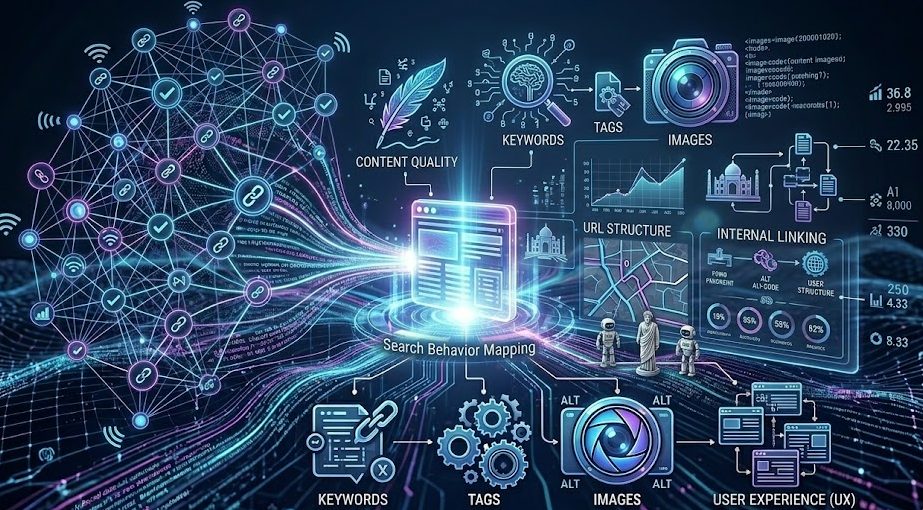
The year is 2026, and the traditional “keyword” is dead.
For nearly two decades, digital marketers obsessed over “strings”—specific sequences of characters typed into a search bar. We optimised for “best running shoes” or “how to bake sourdough.” But as we navigate the mid-point of 2026, the search landscape has undergone a tectonic shift. Search engines are no longer just indexing pages; they are mapping the world. We have transitioned from the era of Search Engine Optimisation to the era of Entity and Intent Optimisation.
If you are still looking at Monthly Search Volume (MSV) as your primary metric, you are looking at a ghost of the past. In today’s AI-dominated environment, success is determined by your ability to map your content to Entities, understand the Contextual Nuance of a query, and predict Search Behaviour Mapping (SBM).
This guide is designed for everyone—from the student trying to understand the fundamentals to the seasoned researcher seeking advanced semantic strategies. Let’s break down the new architecture of discovery.
1. The Fall of the String: Why Keywords No Longer Rule
In 2025, we saw the beginning of the end for keyword-stuffing. In 2026, Large Language Models (LLMs) and AI agents have become the primary filters through which information is consumed.
When a user asks their AI agent, “Find me a durable laptop for video editing that won’t overheat in the desert,” there isn’t one “keyword” that fits. The AI understands the entities (laptop, video editing, desert), the attributes (durable, thermal management), and the constraints (overheating prevention).
The “Topical Dominance” Metric
Instead of ranking for a keyword, we now aim for Topical Dominance. This is a measure of how thoroughly your domain covers an entire subject area. In 2026, search engines evaluate your “Knowledge Graph.” If you want to rank for “Digital Marketing,” you can’t just write a blog post; you must demonstrate authority across the entire semantic web of that topic—from programmatic advertising to the ethics of AI data scraping.
2. Understanding Entities: The Building Blocks of 2026 Search
In the current 2026 ecosystem, an Entity is a “thing” or “concept” that is unique, well-defined, and distinguishable. It could be a person, a place, a brand, or an abstract concept like “sustainability.”
The Semantic Triple: Subject-Predicate-Object
AI models process information in Semantic Triples.
- Subject: Apple (The Entity)
- Predicate: Released (The Action/Relationship)
- Object: M5 Chip (The Target Entity)
As a researcher or marketer, your job is to ensure your content provides these triples clearly. When you write about a product, you aren’t just using keywords; you are defining the relationships between entities.
Pro Tip for Experts: Use Schema.org markup not just for rich snippets, but to define “sameAs” relationships. Link your brand entity to established nodes in DBpedia or Wikidata. This helps the AI agents of 2026 “verify” your identity in the global knowledge graph.
3. Contextual Mapping: Beyond the Search Bar
One of the most profound changes in 2026 is the role of Context. Search is no longer a static event; it is a continuous conversation.
The Three Layers of Context in 2026:
- User Context: Where is the user? What is their previous search history? What device are they using? (e.g., An AR-glass user has different needs than a desktop researcher).
- Environmental Context: Is there a global event happening? Is it a weekend? Is the market crashing?
- Semantic Context: What did the user ask immediately before this query?
Strategy: The “Query Chain” Analysis
In 2026, we researched “Query Chains.” A user doesn’t just search for “home loans.” They search for “current interest rates,” then “calculate monthly payments,” then “best lenders for first-time buyers.”
To capture this traffic, your content must be structured to answer the next logical question before the user even asks it. This is what we call Predictive Content Architecture.
4. Search Behaviour Mapping (SBM): The New Funnel
The traditional marketing funnel (Awareness > Consideration > Conversion) has been replaced by Search Behaviour Mapping.
The Messy Middle of 2026
Research by industry leaders has shown that the path to purchase is a chaotic loop of exploration and evaluation. SBM identifies the psychological triggers that move a user through this loop.
- Exploration: The user is broadening their horizons. They need “What is” and “Why” content.
- Evaluation: The user is narrowing down options. They need “Comparison,” “Pros/Cons,” and “Real-world testing” content.
In 2026, the most successful brands map their keywords to these psychological states. We don’t just target “buy t-shirts.” We target “sustainable t-shirt material comparison for sensitive skin.” This targets a specific behavioural state rather than just a product category.
5. The 2026 Keyword Research Workflow: A Step-by-Step Guide
For students and professionals, here is the modernised workflow for conducting research that actually moves the needle in 2026.
Step 1: Entity Extraction
Start with your core topic. Use AI-assisted tools to extract all related entities. If you are researching “Electric Vehicles,” your entities list should include: Lithium-ion batteries, Solid-state charging, Regenerative braking, Tesla, BYD, Carbon footprint, and kWh metrics.
Step 2: Intent-Gap Analysis
Don’t look at what people are searching for; look at what they are failing to find.
- Analyse Reddit and Quora threads from the last 30 days.
- Look for “How do I…” questions that have no definitive answer in the AI Overviews. These “Intent Gaps” are your biggest opportunities for rapid traffic growth.
Step 3: Sentiment & Tone Mapping
In 2026, search engines recognise the sentiment of a query. Someone searching for “is [Brand] a scam?” has a different sentiment than “is [Brand] worth the price?” Your keyword research must categorise terms by sentiment so you can tailor the tone of your content—persuasive for the sceptics, informative for the curious.
Step 4: The “Zero-Volume” Goldmine
In the past, we ignored keywords with 0-10 monthly searches. In 2026, these are “Hyper-Niche Queries.” Because AI handles broad queries so well, humans are becoming more specific. A “Zero-Volume” keyword like “how to fix a 2024 Bosch dishwasher leak from the bottom left corner” is a guaranteed conversion.
6. Tools of the Trade: The 2026 Tech Stack
Forget simple keyword planners. The 2026 expert uses a “Semantic Intelligence Suite.”
- Vector Database Analysis: Tools that show you how “close” your content is to the top-ranking results in a multi-dimensional vector space.
- NLP Competitor Audits: Using Natural Language Processing to see which entities your competitors are missing.
- Real-time Behavioural Trackers: Platforms that monitor shifting trends on decentralised social media (like the Fediverse or Farcaster) before they hit mainstream search.
7. Advanced Research for Experts: Decoding Vector Search
For the industry experts and researchers reading this, we must talk about Vector Search.
In 2026, search engines convert words into numerical vectors. “King” and “Queen” are mathematically close to each other. When you conduct research, you are essentially looking for the “Vector Space” that is currently underserved.
If you find that the vector space for “Luxury Travel” is crowded with “Price” and “Location” data, but lacking in “Cultural Immersion” data, you have found a semantic opportunity. You don’t need a “keyword” for this; you need to shift the thematic weight of your content.
8. Plagiarism, AI, and the Value of the Human Voice
As a subject matter expert, I cannot stress this enough: The more AI content there is, the more the “Human Signature” is worth. In 2026, Google’s “E-E-A-T” has a hidden “H” for Humanity. Research-grade content must include:
- Unique Anecdotes: “In my 15 years of doing SEO, I found that…”
- Contrarian Views: Don’t just follow the trend. If you think a popular strategy is failing, say why.
- Primary Data: If you conducted a small test on your own site, that data is more valuable than a million AI-synthesised summaries.
Originality isn’t just about avoiding plagiarism; it’s about adding a perspective that didn’t exist before you wrote the piece. In 2026, originality is your best SEO strategy.
9. Common Pitfalls to Avoid in 2026
- Chasing “Short-Tail” Keywords: Ranking for “Marketing” is nearly impossible and often useless. The traffic is too broad.
- Ignoring Voice and Audio Context: People “search” differently when talking to their car or their watch. Use conversational long-form phrases.
- Over-Optimisation for AI: Don’t write for the AI. The AI is designed to find what is best for the human. If you make your content too robotic to “help the bot,” you will eventually be devalued.
10. Conclusion: Mapping the Future
Keyword research in 2026 is no longer a task you do once a month with a spreadsheet. It is a continuous process of understanding human desire, technological capability, and semantic relationships.
To stay ahead, you must look beyond the words. Look at the Entity. Understand the Context. Map the Behaviour.
The digital world is more crowded than ever, but for those who can provide genuine, human-validated, and deeply informative content, the growth opportunities are limitless. The “curve” is always moving—your job is to be the one drawing it.
Is your keyword strategy stuck in 2024? The shift to Entity-based search is the biggest change in the history of the internet. Don’t let your brand get left behind in the “string” era.
Download our 2026 Semantic Research Template or book a Strategy Consultation with our senior analysts to map your brand’s Knowledge Graph today. Let’s make your business an unshakeable entity in the world of AI.



 Visibility Ops
Leave a comment