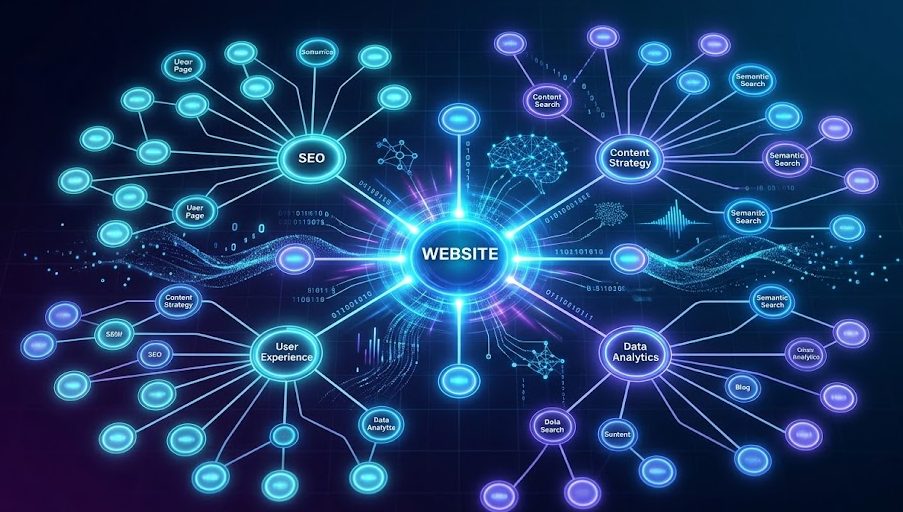
By April 2026, the digital marketing world has reached a point of total saturation. If you are still trying to rank individual pages for individual keywords, you are fighting a losing battle. The AI-driven search engines of today—Google’s Gemini, Perplexity, and the various LLM-based agents—no longer look at your website as a collection of pages. They view it as a Knowledge Graph.
Welcome to the era of Topical Authority.
In this landscape, “relevance” is the bare minimum. What search engines are hunting for now is Inference. Can the AI infer, with high statistical confidence, that your domain is the definitive source of truth for a specific subject? If the answer is yes, you become the “Root Entity,” and your content is served as the primary citation in AI snapshots. If the answer is no, your traffic will vanish into the “Blue Link” graveyard.
This guide is for the students learning the new foundations, the professionals auditing their 2026 maps, and the researchers looking for the edge in semantic connectivity.
1. The 2026 Definition of Topical Authority
Traditional Topical Authority was about writing a lot of articles on one topic. In 2026, it has evolved into Semantic Weight. It is the measure of how much “Information Gain” your ecosystem provides compared to the baseline of the web.
The Inference Gap
The “Inference Gap” is the distance between what you say and what the AI already knows. If your blog post simply summarises the existing top 10 results, your Information Gain is zero. AI models like Gemini will ingest your data, recognise it as redundant, and ignore your URL. To rank in 2026, your ecosystem must provide novelty—a new data point, a unique case study, or a contrarian perspective that shifts the Knowledge Graph.
2. Auditing Your “Semantic Map”
Before you write a single word, you must understand where you sit in the global Knowledge Graph. In 2026, we call this Semantic Map Auditing.
How to Audit Your Domain’s Map:
- Entity Coverage Analysis: Use NLP tools to scan your site and extract the “Top 50 Entities” you are currently associated with. Are these entities closely related, or is your map “fractured”?
- The “Citation Check”: Look at how AI Overviews cite you. Are you being cited for “facts” (low value) or “expert insights/methodologies” (high value)?
- Topical Voids: Identify the “white spaces” in your niche. If everyone is talking about how to use AI in marketing, but no one is providing raw data on AI-driven churn rates in SaaS, that is your void.
Professional Tactic: A “fractured” map—where you talk about SEO one day and Keto diets the next—is the fastest way to lose authority in 2026. Stick to your “Semantic Neighbourhood.”
3. The “Cited Source” Protocol: Designing for Information Gain
To be the source that Google’s API trusts, your content must follow the Cited Source Protocol. This is the heart of human-expert writing in 2026.
The Anatomy of a High-Authority 2026 Post:
- The Original Hypothesis: Start with a claim that isn’t yet “common knowledge” in the LLM training sets.
- The Proprietary Data Point: Include a chart, a screenshot, or a statistic that only you possess.
- The Expert Nuance: Use language that shows lived experience. For example: “While the common consensus in 2025 was X, our internal audits of 400 client sites in Q1 2026 show that Y is actually the primary driver.”
4. Professional Verdict: The Contrarian View on “Content Velocity”
The Verdict: In late 2026, Content Velocity is the enemy of Topical Authority.
Most “experts” will tell you to use AI to publish 100 articles a week to “cover the topic.” This is a mistake. In the 2026 landscape, search engines are implementing “Energy-Efficient Crawling.” If your site produces a high volume of low-Information Gain content, Google will eventually throttle your crawl budget.
My Advice: Publish less, but make every piece an “Authority Anchor.” One 2,500-word piece with original data will outrank fifty 500-word AI-generated summaries every single time. Depth is the only sustainable moat.
5. Programmatic Scalability (pSEO): Scaling Without Diluting
How do you build a massive ecosystem without sacrificing the “Human Signature”? You use Programmatic SEO (pSEO) driven by a Proprietary Database.
The 2026 pSEO Framework:
- Collect Unique Data: Instead of scraping the web, build a database of industry-specific metrics. (e.g., “Average CPM for AI-SaaS in 2026”).
- Create an “Expert Template”: Write a high-quality human introduction and conclusion.
- Inject Data Points: Use your database to populate the “middle” of the pages.
By creating 1,000 pages that all feature different unique data points from your own database, you create a programmatic ecosystem that provides massive Information Gain. This is how you achieve exponential growth by April 2026.
6. The 2026 Hub-and-Spoke Model
To build authority, your site structure must mirror a Knowledge Graph.
- The Pillar (The Root Entity): A massive, 5,000-word guide on a broad topic (e.g., “The Complete Guide to Digital Marketing”).
- The Spokes (The Attributes): Specialised articles that answer very specific “Niche Entities” (e.g., “How to Optimise for AR-Glass Search in 2026”).
- The Connectors (The Predicates): Deep internal linking using descriptive, entity-based anchor text. Don’t use “click here.” Use “Advanced Semantic Mapping Strategies.”
7. Avoiding the “Echo Chamber” Penalty
In 2026, Google introduced the “Echo Chamber Penalty.” If your website only links to sources that say the exact same thing as you, you are viewed as a “Closed Loop” and your authority score drops.
The Fix: Link to reputable sources that disagree with you or offer a different perspective. This shows the search engine that you have conducted thorough research and are providing a balanced, comprehensive view. This is what researchers call Academic Rigour, and it is a massive trust signal in 2026.
8. Measuring Success: The Semantic Reach Metric
In the past, we measured success by “Rankings.” In 2026, we measure Semantic Reach.
- Snapshot Presence: What percentage of queries in your niche result in an AI Overview citing your site?
- Inferred Searches: Is your brand name being searched alongside your top entities (e.g., “Search for [Your Brand] SEO Strategy”)?
- Secondary Citations: Are other authority sites citing your original data?
9. Conclusion: Becoming the Unshakeable Authority
Building Topical Authority in 2026 is no longer about “gaming the system.” It is about becoming the system. By focusing on Information Gain, auditing your Semantic Map, and using JSON-LD to bridge the gap between human creativity and API logic, you build a fortress that AI cannot ignore.
April 2026 is a turning point. The brands that provide genuine, human-validated, and technologically connected information will see exponential growth. Those that don’t will simply be “synthesized” into the background noise of the internet.
Is your content ecosystem fragmented? An invisible Semantic Gap could be preventing your site from reaching the top of 2026’s AI Snapshots. Download our “2026 Semantic Map Audit Tool” or book a consultation with our Chief Strategy Officer to turn your website into a Trusted Root Entity. Let’s build your authority together.

 Visibility Ops
Leave a comment