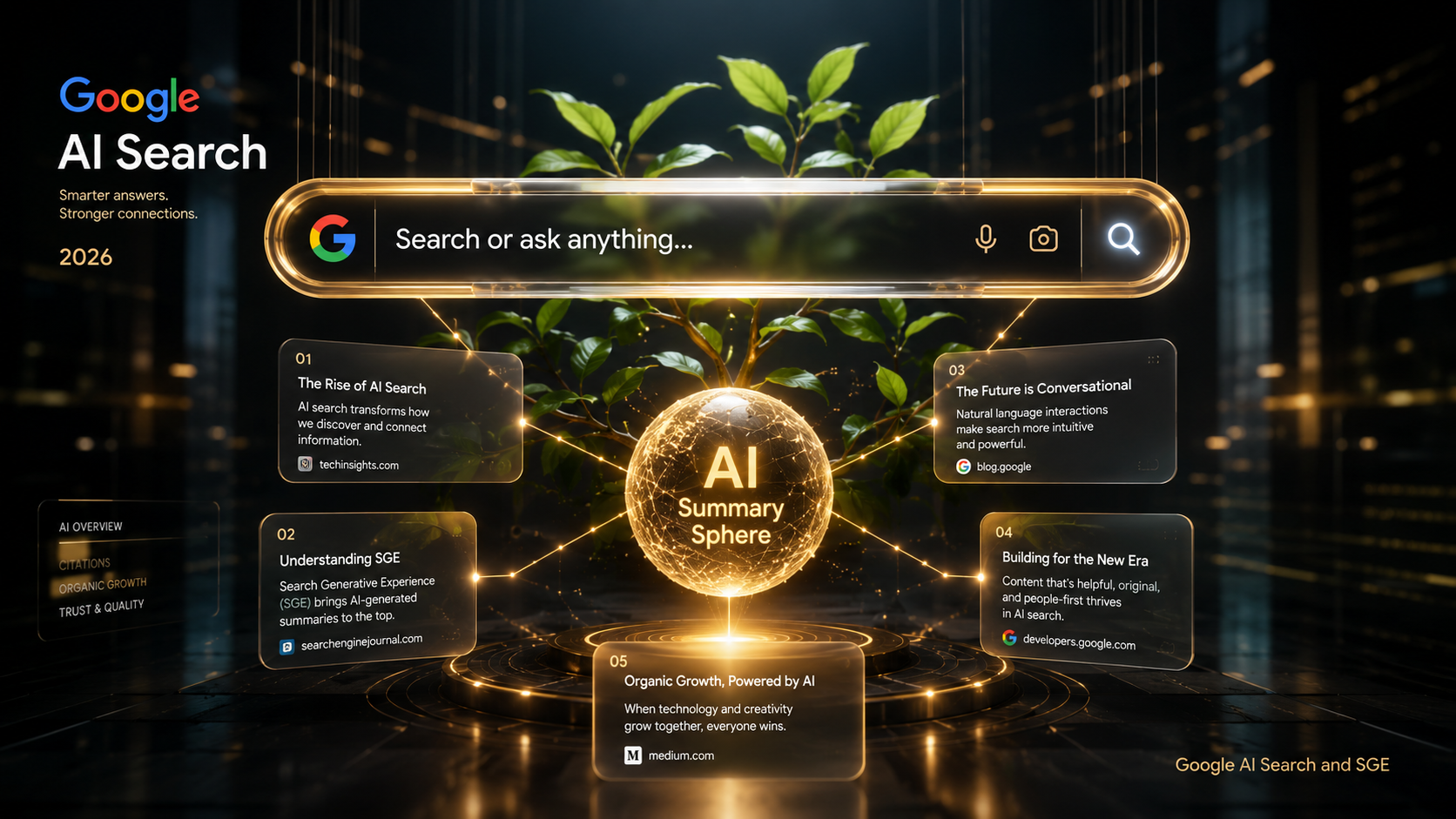
Google AI Search & SGE in 2026: How Content Gets Selected, Summarised, and Shown Without Clicks
The search landscape of 2026 is no longer a directory of destinations. It has transformed into a synthesis engine.
For nearly three decades, search engine optimisation was a predictable pipeline: a user typed a query, Google displayed a list of “Blue Links,” and the user clicked through to a website. Today, Google’s AI-generated summaries, contextual snapshots, and SGE-style interfaces solve user queries directly on the search results page.
If your website relies on traffic from simple informational queries, you are likely watching your click-through rates decline.
To survive this transition, your digital strategy must shift from traditional keyword targeting to Retrieval-Optimised Authority (ROA).
Definition: Retrieval-Optimized Authority (ROA) In 2026, ROA is the strategic alignment of content structure, information density, and verified entity relationships that allows Large Language Models (LLMs) to easily extract, synthesize, and attribute your proprietary insights in zero-click search summaries.
1. What Google AI Search and SGE Actually Are in 2026
Google’s search engine is no longer just matching text strings to an index of documents. It is running a highly sophisticated, real-time Retrieval-Augmented Generation (RAG) loop.
When a user executes a query, Google does not simply look for pages containing those words. Instead, it translates the query’s underlying intent into a multi-dimensional mathematical vector. It then queries its index for the most contextually relevant “Entity Nodes”—trustworthy sources of facts, data, and expert analysis.
The search engine’s core LLM then reads these top-performing documents, extracts the key arguments, and synthesises a singular, cohesive answer right on the screen. The traditional organic listings are relegated to small citation cards or drop-down footnotes beneath the AI’s response.
The 2026 Reality: If your page is merely selected to be read by the AI but fails to offer a compelling reason for the user to click through, you are acting as unpaid training data for Google’s model. You must learn how the selection engine works to force the user past the summary.
2. The Core Mechanism: How AI Answers Are Built
To influence how your content is shown, you must first understand the three-step pipeline Google uses to construct every AI search snapshot:
[User Query] ➔ [Vector Retrieval & Entity Filtering] ➔ [LLM Synthesis & Citation Anchoring]
- Step 1: Contextual Parsing: The search engine analyses the user’s explicit query, historical search behaviour, location, and device to build a highly personalised “Intent Profile.”
- Step 2: Candidate Retrieval: The system retrieves a small pool of high-authority candidate pages from its index. These pages are chosen based on their topical weight, factual accuracy, and domain authority.
- Step 3: Synthesis & Citation: The LLM scans the candidate pages, identifies overlapping consensus points, highlights unique “Information Gain” variables, and writes the final summary. It places citation anchors (the clickable source links) directly next to the specific facts or insights it extracted.
3. The Selection Algorithm: Why Some Pages Get Summarised While Others Are Ignored
Why does one piece of content get selected as a primary citation card while an equally well-written competitor is left in the dark? It comes down to Data Extraction Efficiency.
Real-World Case Study: The Battle of Two Financial Articles
To understand this dynamic, let us look at how Google’s AI parsed two competing articles on “2026 Small Business Tax Strategies” last month.
- Article A (The Traditional Blog): Written using a standard 2024 SEO template. It started with a long, fluffy introduction about why taxes are stressful. It used vague, narrative subheaders like “Things to Keep in Mind” and buried its primary recommendations deep within long paragraphs of text.
- Article B (The Retrieval-Optimised Asset): Started with a tight, 3-sentence summary of the new 2026 tax codes. It used direct, question-based headers like “How does the 2026 R&D credit affect bootstrapped SaaS?” Every recommendation was structured in an explicit, noun-verb-object format with a supporting data point.
The Result: Google’s AI completely ignored Article A. The model could not easily parse the unstructured narrative text within its tight context window.
Article B, however, was selected as the primary cited source in the AI Overview. It’s clean, semantic structure made it incredibly easy for the model to extract facts and present them to the user.
Visual Strategy: Insert a split-screen comparative graphic here. On the left, show Article A’s messy, paragraph-heavy structure with red marks indicating AI extraction failure. On the right, show Article B’s clean, modular, entity-dense layout highlighted in green, showing successful AI synthesis. Caption: How AI systems visually scan and extract information. Clean, entity-dense hierarchies are selected; narrative fluff is discarded.
4. Professional Verdict: The Death of the “Rank #1” Trophy
The Verdict: In 2026, ranking #1 for broad keywords is a vanity metric that no longer correlates to business revenue.
For two decades, the holy grail of digital marketing was capturing the first position on the search engine results page. In the current landscape, that position is often pushed below the fold by a massive AI Overview box.
If your target term triggers a zero-click AI summary, being the “first blue link” might only yield a fraction of the traffic it did two years ago.
My Advice: Stop auditing your site for “positions.” Start auditing your site for Citation Share and Intent-Chain Capture.
Your goal is to be featured inside the AI Overview box itself as a cited source, and then to offer “Decisive Utility”—such as a downloadable tool, a proprietary data sheet, or a contrarian perspective—that forces the user to click your citation to get the complete solution.
5. Structuring Content for AI Extraction: The Tactical Blueprint
To ensure your writing is easily processed by Google’s extraction models, you must adopt a highly structured, “Predictive” formatting style.
Tactic 1: The “Entity-First” Sentence Structure
AI models process information more efficiently when sentences are written in a simple, active voice that clearly defines the relationship between two entities.
- Avoid: “It has been argued by many industry leaders that perhaps adopting a more agile content framework might yield better results over time.” (Too passive, low information density).
- Use instead: “Agile content frameworks increase domain crawl efficiency by reducing index bloat.” (Clear entity-action-effect structure).
Tactic 2: Implement “Summary-First” Anchors
At the beginning of every major H2 section, provide a single, bolded sentence that answers the header’s question directly. This acts as a “Synthesised Nugget” that Google’s LLM can easily copy and paste into its search snapshot.
Tactic 3: Maximise Tabular and Structured Data
AI models are highly visual learners. When you present data in a structured table or a clean bulleted list, you make the relationship between variables unmistakable.
- Use tables to compare products, prices, or technical specifications.
- Use numbered lists to outline sequential workflows.
6. How AI Systems Evaluate Trust and Usefulness
Google’s 2026 algorithm is trained to spot and penalise “derivative noise.” If your blog post says the exact same thing as the rest of the web, the AI views your domain as redundant.
[High Redundancy Index] ➔ [Devalued Crawl Budget] ➔ [Exclusion from AI Snapshots]
The Three Trust Pillars of 2026 Search:
- Information Gain: Does this document offer a new perspective, a proprietary dataset, or a unique expert angle that does not exist in the training corpus?
- Verification Anchors: Are your facts backed by primary sources? Do you link out to authoritative, non-competing domains that validate your claims?
- The “Human Signature” Metric: Does your content feature elements that a machine cannot easily replicate? This includes personal anecdotes, detailed failure logs, and professional intuition.
7. The Future of Organic Traffic: The “Decisive” Era
As we navigate the rest of 2026, organic traffic is not disappearing; it is consolidating.
The casual searcher who wants a quick, transactional answer (“What is the capital of France?”) will never visit a website again. That traffic is gone, swallowed by zero-click AI answers.
However, the high-intent researcher—the buyer looking for deep comparisons, technical troubleshooting, or strategic consulting—is clicking through more than ever. They use the AI summary to filter out the generic brands, and then they click on the one citation that promises true, unsummarizable depth.
To capture these high-value users, your content must transition from being “helpful” to being decisive. You must own the next step of their digital journey.
8. Five Common Mistakes That Get Your Content Ignored
- Writing Wall-of-Text Introductions: If a user has to read 400 words of background context to find the answer to their query, the AI parser will time out and move to a more efficient competitor.
- Using Fluffy Headings: Headings like “A Deeper Dive” or “Looking Closer” contain zero semantic value. Use descriptive, entity-focused headers.
- Hiding the Main Conclusion: Place your primary findings at the very beginning of the post, not at the end of a long narrative.
- Avoiding Contrarian Views: AI search loves balanced, comprehensive summaries. If your site offers a well-reasoned, contrarian counter-argument, the AI is forced to cite you to provide a complete overview.
- Polishing Out the Human Element: If your content is too perfect, too balanced, and too clean, it looks identical to an LLM’s own generation. Keep the human voice, complete with professional opinions and unique writing cadences.
9. Conclusion: Outgrowing the Algorithm
Winning the organic traffic battle in 2026 is not about trying to trick Google’s AI. It is about understanding that the search engine is looking for original, highly structured, and deeply authoritative human intelligence to feed its users.
By optimising your content for extraction while preserving a rich, irreplicable “Human Signature,” you build an unshakeable digital presence. Google’s AI Overviews will have no choice but to cite your brand, transforming zero-click search from a threat into your greatest growth engine.
Is your organic traffic slipping away into Google’s AI Overviews? If you are writing for yesterday’s search engines, you are invisible to today’s buyers. Download our “2026 AI Extraction Audit Checklist” to see exactly how Google’s models read your site. Book a high-level Content Strategy Session with our team today, and let’s turn your expertise into the web’s most cited source.
Leave a Reply