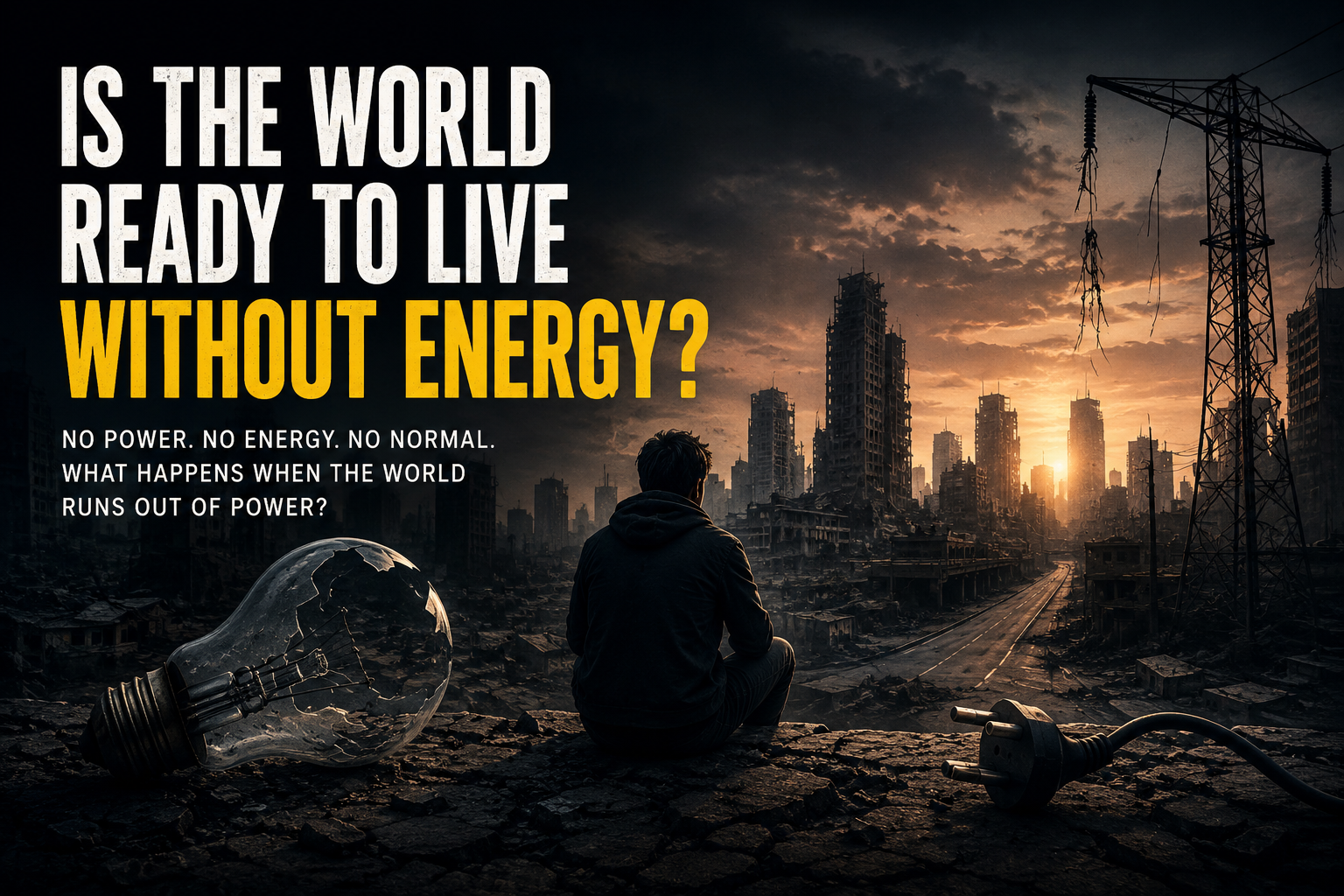
What would happen if the power went out tonight… and never came back?
Not for an hour.
Not for a day.
But forever.
No glowing streetlights outside your window.
No buzzing phone in your hand.
No internet.
No fuel.
No electricity.
No invisible stream of energy is carrying modern civilisation on its back.
Would humanity survive?
Or have we built a world so dependent on energy that even a few powerless days could push society toward chaos?
We rarely think about energy because it has become too normal. Too available. Too silent. A switch is pressed, and light appears. A charger is plugged in, and the connection returns. A vehicle starts, a hospital functions, a satellite communicates, a city breathes.
But what if all of it suddenly stopped?
Would we even know how to live anymore?
Humanity’s Dangerous Dependence on Electricity
The modern world runs on energy every second. Our homes, transportation systems, businesses, hospitals, and even social interactions rely on electricity and digital infrastructure. This growing dependence on electricity has made human life more comfortable, but it has also made civilisation extremely fragile.
Imagine a permanent power grid failure affecting major countries around the world. No online payments. No fuel supply chains. No refrigeration. No communication systems. Within days, society could experience panic, shortages, and economic collapse.
The frightening reality is that most people today do not know how to survive without electricity because technology has become deeply integrated into everyday life.
Energy Is Not a Luxury Anymore — It Is Survival
Centuries ago, humans could survive without electricity. Villages lived under moonlight. Food was grown manually. Communication travelled through footsteps and handwritten letters.
But today?
Energy is no longer a tool. It is the nervous system of civilisation.
Every major system we depend on survives because energy flows through it constantly.
Hospitals rely on electricity to keep patients alive.
Banks rely on servers to protect money.
Airports rely on radar systems.
Water treatment plants rely on electric pumps.
The internet, the very thing connecting billions of humans, survives because giant data centres never sleep.
Even your food exists because of energy.
Think about it carefully.
How many people today grow their own food?
How many know how to survive without refrigeration?
How many cities could survive if fuel trucks stopped moving for just one week?
Modern humanity doesn’t merely use energy.
It depends on it emotionally, economically, physically, and psychologically.
And maybe that dependency is far more dangerous than we realise.
One Blackout Is Enough to Reveal the Truth
Whenever a city faces a major blackout, panic arrives almost instantly.
Traffic lights fail.
Shops shut down.
ATMs stop working.
Phones slowly die.
Water systems begin struggling.
People rush to stores.
Fear spreads faster than information.
Why?
Because deep down, humanity understands one terrifying truth:
We are only a few powerless days away from disorder.
The modern world appears strong from the outside, with giant skyscrapers, advanced technology, artificial intelligence, digital banking, smart homes, satellites, and electric vehicles.
But beneath all of that sophistication lies a fragile reality.
Remove energy… and civilisation suddenly becomes helpless.
A farmer with basic survival knowledge from 200 years ago might survive longer than a modern urban citizen surrounded by dead machines.
Isn’t that ironic?
The more technologically advanced we become, the more vulnerable we also become.
The Invisible Addiction Nobody Talks About

People talk about addiction to social media.
To money.
To fame.
To entertainment.
But humanity’s greatest addiction may actually be energy itself.
Wake up and check your phone.
Turn on the lights.
Use hot water.
Charge devices.
Travel using fuel.
Work on computers.
Order food online.
Watch content before sleeping.
Every hour of modern life quietly consumes energy.
And because it is always available, we rarely respect it.
But imagine losing it for a month.
No internet.
No refrigeration.
No GPS.
No digital payments.
No social media.
No streaming.
No elevators.
No online work.
No instant communication.
Would people adapt peacefully?
Or would the silence expose how fragile human comfort really is?
The Psychological Collapse Would Be Worse Than the Physical One

Most people imagine darkness when they think about a world without energy.
But darkness would not be the biggest problem.
The real collapse would happen inside the human mind.
Today, people are mentally dependent on constant stimulation. Notifications. Entertainment. Connectivity. Artificial light. Endless scrolling. Digital validation.
Without energy, humanity would be forced to face something it has been avoiding for years:
Stillness.
No distractions.
No algorithm.
No escape.
Just silence.
Could modern humans tolerate that?
Or have we become so connected to machines that we no longer know how to exist without them?
Maybe energy powers more than our homes.
Maybe it powers our identities, too.
Even the Strongest Nations Are Vulnerable
People assume powerful countries are protected because they have advanced infrastructure.
But advanced systems require even more energy.
A single cyberattack on power grids can disrupt millions of lives.
Fuel shortages can cripple economies.
Natural disasters can destroy electricity networks overnight.
The terrifying part is this:
Human civilisation is deeply interconnected.
If energy systems fail in one major region, the consequences spread globally, supply chains collapse, communication weakens, economies panic, and social stability begins to crack.
We often believe humanity controls technology.
But what if technology now controls humanity’s survival?
Renewable Energy Gives Hope — But Also Raises Questions
Yes, the world is trying to evolve.
Solar energy.
Wind power.
Hydroelectric systems.
Electric vehicles.
Sustainable innovation.
Humanity understands that traditional energy resources are limited. That climate change is real. That overconsumption carries consequences.
But even renewable energy cannot solve the deeper question:
Have we built a civilisation that consumes more energy than human beings actually need?
Maybe the problem is not only where energy comes from.
Maybe the problem is how dependent we have become on constant consumption itself.
Can a civilisation addicted to speed ever slow down willingly?
The Final Question Humanity Must Face
The future of humanity may not depend only on artificial intelligence, technological growth, or economic power. It may depend on something far more basic — sustainable energy and our ability to survive without complete technological dependence.
As conversations around renewable energy, energy consumption, and global energy crises continue to grow, humanity faces an uncomfortable truth:
We built a civilisation powered entirely by electricity…
But did we also build one incapable of surviving without it?
And if the lights went out forever tomorrow…
What would remain of modern humanity?
Leave a Reply